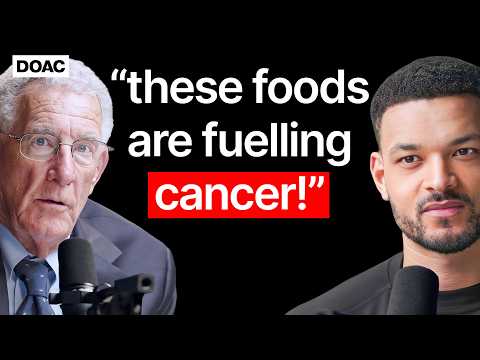
Leading Cancer Researcher: They’re Ignoring My Research, Cancer Patients Must Know This!
Ask about The Diary Of A CEO
Episode Description
1,700 Americans will die from cancer today. 70 every single hour. Professor Thomas Seyfried says it doesn't have to be this way, and that mainstream oncology has misunderstood cancer for 100 years.
Thomas Seyfried, PhD, is a professor of biology at Boston College and one of the world's leading researchers on the metabolic origins of cancer. He is author of the book 'Cancer as a Metabolic Disease: On the Origin, Management, and Prevention of Cancer' and co-developer of the Glucose Ketone Index (GKI) and the “press-pulse” therapeutic strategy.
He explains:
◼ Why he believes cancer is a mitochondrial metabolic disease, not a genetic one
◼ Why cancer cells feed on two fuels and the strategy his team uses to starve tumors
◼ How a ketogenic diet lowers your GKI and makes chemo and immunotherapy work better
◼ The environmental drivers quietly damaging your mitochondria
◼ How his team is keeping glioblastoma patients alive for years, and why almost no patient is ever told this option exists
The views expressed are those of the guest, and this conversation is intended for general informational purposes only. This podcast and its associated materials should not be used as a substitute for professional medical advice, diagnosis, or treatment.
00:00:00 Intro 00:02:42 The New Discovery About Cancer 00:03:43 What Role Do Mitochondria Play in Cancer? 00:08:12 ATP & Fermentation: How Your Cells Make Energy 00:15:00 The Oncogenic Paradox Finally Explained 00:20:19 Ghost Mitochondria: Cancer Under the Microscope 00:25:19 Glucose & Glutamine: The Fuels That Feed Cancer 00:26:32 Why Do Children & Babies Get Cancer? 00:29:25 Why Wealthy Countries Have More Cancer 00:32:55 Is Cancer Genetic? 00:37:58 The Prescription: The Glucose Ketone Index 00:40:23 How Stress & Poor Sleep Fuel Cancer 00:44:54 What's Inside the Confidential Envelope? 00:45:58 The Patient Who Inspired the Discovery 00:50:25 Measuring Your Glucose Ketone Index Live 00:53:01 The 'Red Zone' Link To Cancer 00:58:02 The Man Who Survived Glioblastoma for 10 Years 00:58:55 Using the Keto Diet to Supercharge Chemo 01:07:32 The Experiment That Could Prove Cancer Isn't Genetic 01:08:30 1,700 Cancer Deaths a Day: Seyfried's Warning 01:13:41 Seyfried's Plan to End the Cancer Epidemic 01:16:25 What Foods You Should Actually Eat 01:21:58 Fasting Protocols & Hitting 'The Wall' 01:26:48 Hyperbaric Oxygen Therapy & Cancer 01:28:30 Microplastics & 'Forever Chemicals' 01:30:47 How Cancer Spreads: Metastasis Explained 01:37:27 The #1 Actionable Takeaway 01:39:45 Energy, Hope & Final Words
Follow Professor Thomas:
◼Instagram - https://link.thediaryofaceo.com/1MRuOwr
◼X - https://link.thediaryofaceo.com/DDF9xxr
◼Substack - https://link.thediaryofaceo.com/HKsGFcF
◼ Professor Seyfried's Biology Department - https://link.thediaryofaceo.com/HKwWhwD
◼ Foundation for Cancer Metabolic Therapies - https://link.thediaryofaceo.com/6Ehj3Hh
◼ Elizabeth Ann Weathers Breast Cancer Research Fund - https://link.thediaryofaceo.com/Bf10aHy
A message from Professor Seyfried: “If you would like to support research on the mitochondrial metabolic theory of cancer, please consider donating to our research. Please remember that no donation amount is too small or too large.”
The Diary Of A CEO:
◼ Join DOAC circle here - https://doaccircle.com/
◼ Buy The Diary Of A CEO book here - https://smarturl.it/DOACbook
◼ The 1% Diary is back - limited time only: https://bit.ly/3YFbJbt
◼ The Diary Of A CEO Conversation Cards: https://linkly.link/2hm7r
◼ Get email updates - https://bit.ly/diary-of-a-ceo-yt
◼ Follow Steven - https://g2ul0.app.link/gnGqL4IsKKb
Sponsors:
Wispr - Get 14 days of Wispr Flow for free at https://wisprflow.ai/steven Eight Sleep - http://eightsleep.com/steven use code STEVEN for up to $350 off. 30-day at-home trial. Free returns. Ekster Link: https://link.thediaryofaceo.com/GSNEWnm
Read the full transcriptHide the full transcript
- You have an envelope in front of you there that says confidential on the front of it. What is in that envelope?
- >> It's a paper that's under embargo because the world thinks it's going to be very important and it's going to be a
- lead article in the frontiers in science because this is a strategy to manage cancer effectively and we have a lot of
- evidence to keep these people alive a hell of a lot longer. We have given hope to the hopeless
- >> and you have a perspective on treating cancer and other metabolic diseases that
- others don't have. >> Yes. But the problem is the field doesn't understand what I'm saying about
- the origin of cancer. So everything comes back to mitochondria and all chronic diseases in cancer are the
- result of damage to this and the science is telling us this. But the field of cancer has yet to accept it. That is a
- tragedy. >> Are you pissed off about this? >> Well, who wouldn't be? There's 1,700
- people a day in this country dying from cancer. That's 70 an hour. And it gets worse every single year. When is the
- people going to wake up? So give me a prescription of how I should live my life to keep my mitochondria healthy.
- >> So it all comes down to what you do to maintain the health and vitality of the
- mitochondria that reduce the risk. But we are now in a new environment where we have massive amounts of highly processed
- carbohydrates, inactivity, emotional stress, poor sleep habits and you chronically damage this organel. And
- then if you look at the domestic dog, cancer is the number one killer of the domestic dog. But wolves in the wild
- rarely have cancer. But the wolf is out running around eating natural foods. Yet
- the dog is in an apartment somewhere gets a dog walker once a day, right? And the next thing the dog is obese and full
- of cancer. >> And I want to give people actionable things that they can think about.
- >> So this is what's really important. This is a bioenergetic road map to health.
- This is what we call the zone of prevention. It's very hard to get cancer or chronic diseases when you're in these
- zones. >> So let's talk about that. >> So this is super interesting to me. My team
- given me this report to show me how many of you that watch this show subscribe. And some of you have told us according
- to this that you are unsubscribed from the channel randomly. So favor to ask all of you, please could you check right
- now if you've hit the subscribe button if you are a regular viewer of the show and you like what we do here. We're
- approaching quite a significant landmark on this show in terms of a subscriber number. So, if there was one simple free
- thing that you could do to help us, my team, everyone here, to keep this show free, to keep it improving year over
- year and week over week, it is just to hit that subscribe button and to double check if you've hit it. Only thing I'll
- ever ask of you. Do we have a deal? If you do it, I'll tell you what I'll do. I'll make sure every single week, every
- single month, we fight harder and harder and harder and harder to bring you the guests and conversations that you want
- to hear. I've stayed true to that promise since the very beginning of the DEO, and I will not let you down. Please
- help us. Really appreciate it. Let's get on with the show. >> Professor Thomas Seaf Freed, what is it
- that you've committed your life to doing, Thomas? >> Well, we're right now committed our
- lives to managing cancer effectively uh without toxicity which is based on based on the science that I and other
- others have done in this field. >> You have a perspective on treating cancer and other metabolic diseases that
- others don't have. the mainstream should I say. >> Oh yeah. Well, mainstream doesn't have
- it for sure. But it's based on science. I mean I'm my work is based on what Otto
- Warberg the famous German scientist said from the 1920s30s and 40s. He clearly showed that cancer was a mitochondrial
- metabolic disease. >> What does that mean mitochondrial metabolic disease? >> Okay. It means that the origin of the
- disease resides in the organel called the mitochondrian. It's it's in the cytoplasm of the cell. It used to be
- called still is the the powerhouse of the cell. Gives the cell the energy. >> I think we have a mitochondria. Could
- one of my team bring in a mitochondria? >> Well, this is you have a a mitochondria
- in here. Oh, here we go. >> You got one each here. >> Yeah. Well, see, this is the little
- organel that you see. It looks like a bean shape, but it's actually a tubular network. These are tubes
- >> and they respond dynamically inside the cell to uh both internal uh activities
- as well as external activities. So you have to realize that at the time of conception
- uh all of the mitochondria for the developing embryo are in the cytoplasm from the mother.
- >> The cytoplasm >> the mitochondria are not in the nucleus. They're in the cytool. Oh, outside of
- the >> outside of the nuke, but in the cell body itself. So all of the mitochondria,
- they determine our destiny. They will determine how long you will live on the planet if if you don't have an
- unfortunate accident or something like this. They have an expiration date. Different species die at different
- times. You don't find people living 400 years. Mice live about two and a half years. Elephants live, you know, as long
- as we do or whatever. But that's all determined by this organel. So you can see I have wrinkles and this kind of
- thing. This is from living on the planet and this is from wear and tear on this organel which allows us to make energy
- efficiently. >> So when this organel starts to falter with age uh you die you die from old
- age. This organel has to be protected and respected if you would like to live a normal lifespan. But in diets and
- lifestyles and way we are today we we we damage this organel and this organel then can present itself damage to this
- organel which is a tubular network inside the cell. But let me say something else. It not only controls the
- internal environment of the cell. It also controls the neighboring cells. The liver neighborhood the lung neighborhood
- the colon neighborhood the brain neighborhood the gal neighborhood the neuron neighborhood. But they're all
- come from the same origin in that cytoplasm and they determine the overall metabolic health of your body. It's a
- systemic they communicate uh with each other across cells across tissues. I'll tell you this organel
- controls a lot of what goes what that nucleus does. It tells the cell when to divide. It tells the cell when to slow
- down. >> It's kind of like a brain but also like an engine room. >> It's kind of like that. Certainly
- certainly the brain part of it is really mysterious uh in the sense of of how it
- controls the destiny of the cell in the body. So sickness sickness disease cancer what do we know
- about the role that this little thing plays in these chronic diseases and illnesses and cancers that so many
- people suffer with? >> Yeah. Well, this is the organel that becomes damaged. Um and it can be
- damaged in many many different ways. uh for cancer is what we have spent a lot of our time on and now we've moved into
- the whole chronic disease issue because each each chronic disease can have different manifestations of ill health
- to the mitochondria in a particular population of cells. But in the case of cancer which is what we call the most
- serious of the chronic diseases creating the most trauma uh the most emotional distress but we have clearly shown based
- on on many many works that any multiple things from our environment can damage this organel in a particular population
- of cells in a particular organ. For example, when you talk about carcinogens, it's a chemical that causes cancer. How
- does that chemical cause cancer? It damages the proteins and the lipids. These little squiggles are delicate
- internal membranes. They they contain the proteins and the lipids that allows us to generate energy when we breathe.
- Okay, you're breathing. I'm breathing. I take in oxygen. Oxygen serves as a kind
- a a final acceptor for electrons that allows ATP uh to come out of this little and don't forget it's a tubular network
- >> and ATP is the energy currency. >> It's the chemical energy currency. It allows us to enzymes to work allow
- allows all the metabolic machinery inside of a cell to work optimally. >> So just to play this back to you so I
- know I'm clear. Oxygen comes in because I breathe in. I then eat food >> in in that mitochondria. It does a
- process and it spits out ATP as the energy. >> Well, and and the waste products of a
- good energy metabolism would be CO2 and water. So, when we burn gasoline in an engine of a car, we break down the
- octane, the carbon hydrogen bonds in an octane and and we have an internal explosion that drives pistons. Okay? The
- exhaust is a lot of waste products uh from breaking down the M that we're doing the same thing inside the cell.
- We're combusting carbon hydrogen bonds and that combustion of carbon hydrogen bonds is a graded process. So it's not
- an immediate explosion. It's a it's a you're you're breaking down the carbon hydrogen bonds in a very precise way
- producing ATP which then drives the entire machinery of the neurons and the rest of the body.
- >> It can respond dramatically to energetic stress, emotional stress. Anyway, I gave
- you an example of a carcinogen uh intermittent hypoxia like people who have sleep apnea. They stop breathing
- for 30 seconds or more in that general and then they that creates rust RO and that's what carcinogens do ROS. These
- are called reactive oxygen species. They damage those delicate membranes. And then what happens if it's too acute, too
- stressful, the whole cell will die. the cell loses its energy and we get uh apoptosis or necrosis cell death. But if
- it's gradual chronic over years, months, years, this organel loses its ability to produce sufficient
- energy. But the the cell compensates interestingly enough by using these ancient pathways heirlooms of our
- evolutionary past. So um because all life on the planet evolved in in oxygen but without oxygen in the dark uh these
- cells grew like crazy. There was no they were single cells. They unbridled proliferation and all this kind of
- stuff. They didn't have mitochondria. They had bacteria and the bacteria which this organel came from was a
- fusion between one cell uh that had a nucleus and and was was fermenting through the cytoplasm and this bacteria
- which is the mitochondria came in and now you have two different forms of energy. You have um the energy in the
- cytoplasm, the ancient fermentation, and then you have this new form which can take in oxygen and generate energy much
- much more efficiently than the airlumic. Listen, one of our big discoveries, if you can believe it. But you see that
- space in the middle there? >> Yeah. >> That's called the matrix. And that's where the KB cycle, the TCA cycle, which
- breaks down the food that we eat. But they have an ancient part of a fermentation mechanism inside because
- before oxygen came every all life forms were fermenttors. They they produced energy without oxygen because there was
- no oxygen. We had to wait for those bacteria to make oxygen through a photosynthetic process. But all
- organisms were fermenttors in the beginning after this organel came in and was able to take in oxygen make energy
- really really quick. But in that matrix they have a uh in the cycle there's a little pathway there that makes energy
- without oxygen from the evolutionary past. So we have it in the cytoplasm of the cell because they can use they can
- ferment in the cytoplasm. But this organ that our big discovery with the work of
- of Christounis from semlice university he's the world leader on that little pathway. When this organel becomes
- impaired, these ancient pathways of energy through fermentation arise. Okay, they they try
- to replace the lost energy from the efficiency of this organel. That space starts throwing out ATP
- from glutamine. It's another fermentation fuel and and it's making it's making ancient energy in the
- sophisticated organel that was that was that that evolved to make efficient energy. So let me let me tell you. So
- you get you asked me what about damaging this organel and what happens if the damage to oxidative phosphorilation
- >> what does that mean? >> Which means energy through oxygen >> is too acute the cell will die.
- Cyanide is a a perfect example of this. You take a mouse or a rat or a person and you drink Kool-Aid, the cyanide
- laced Kool-Aid, you die because what happens is that cyanide binds to the protein that's going to um um use oxygen
- for energy and the whole system shuts down. >> Suffocates you basically. >> Yeah. You die in instantly. Um and there
- are other things that can kill uh can kill uh quickly aid and a variety of other chemicals but for chronic diseases
- it's usually u not an acute stress on this organel it's a it's a chronic stress and in cancer what happens in a
- particular tissue whether it's bone lung bladder brain they gradually compensate
- with these ancient fermentation pathways so so this thing this organel cell signals to the nucleus I'm suffoc I'm
- not getting enough energy. Um so the nucleus turns on the transporters on the surface of the cell to bring in fuels
- that will elevate energy through what we call uh oxygen independent mechanisms. This is an oxygen dependent organel.
- This gets most of its energy because we breathe, all of our cells are using oxygen and the CO2 that we're blowing
- out and the water that will be collected in the form of urine when you might put
- uh other waste products in there. That's efficient metabolic homeostasis. This organel makes not only the cell but the
- whole body in a state of of metabolic homeostasis where all systems are working at optimal efficiency. But with
- chronic disruption, uh, smoking, uh, lack of exercise, you can go right down the list of all of the different things
- that can elicit cancer, any kind of carcinogens, microplastics, forever chemicals, uh, uh, uh, glyphosate and
- any of these kinds of things that would chronically damage uh, the ability of this organel to produce energy. Viruses,
- ankcoenic viruses, inflammation. you have chronic inflammation. Any of those things damage this the sophisticated
- ability of this organel to produce sufficient energy. That's why that's why um uh the ankcogenic paradox which we
- solved. >> What's the ankcogenic paradox? >> That was the paradox that was first put
- out by Albert St. Gorgi Hungarian uh scientist who received a Nobel Prize I think for vitamin C. He said he said he
- was very interested in cancer and living systems. He said there's a paradox. He said we know multiple things in the
- environment can elicit cancer. We've identified these ankcogenic viruses, chronic inflammation, carcinogens,
- intermittent hypoxia, rare rare germline mutations. He said we don't understand the common pathophysiological
- mechanism by which any of those provocative agents would elicit disregulated cell growth which is
- cancer. When you talk about cancer, what do people say what is cancer? It's cell
- division out of control. It's disregulated cell growth. This organel determines when cells should divide and
- when they should not divide. It regulates the destiny of the cell. So what happens when this organel becomes
- chronically impaired? It falls back on these ancient pathways, these or or these or um uh pathways that existed
- before oxygen came into the environment where all the cells were disregulated in
- the growth because they didn't have this regulatory system which is the mitochondria coming from a from a
- bacteria. >> So let me play that back to you in a way just so I you know make sure I
- understand. >> I I know it can be kind of deep. >> Okay. So in this mitochondria here that
- I have in front of me, there is an ancient um because this came from the >> bacteria
- >> a fusion of bacteras a long long time ago. >> Yeah. >> The old bacteria >> about several billion years ago
- >> used to be very selfish and just think about itself. It used to grow on its own
- and didn't communicate with anybody. Had its own way of growing and multiplying that was really not um in cohesion with
- anything else. That is still in there somewhere. And although now in its modern form because there's been that
- fusion it grows thinking about the wider organism um when it becomes damaged it falls back on that old selfish way of
- growing and sometime and that's kind of what can cause cancers. So if you if there's stresses on this which could be
- all the car carogenic things you described then sometimes this falls back on that prehistoric selfish way of
- growing where it doesn't think about the wider organism. >> It's close um um in the sense of
- thinking we don't know about that we just know the consequences of what happens when it falls back on those
- ancient pathways. Now here's the situation. People knew from Otto Warberg said cancer is a energy problem in the cell.
- This why would the cells start to ferment and produce a massive amount of fermentation waste product which is
- lactic acid. Even in the presence of oxygen, 100% oxygen, they're still fermenting. Why? That shouldn't happen.
- Uh when you and I hold our breath or have a heart attack, let me tell you something. This is really remarkable and
- this is another piece of information that got us on this whole thing. When people have heart attacks, uh they stop
- breathing, the heart seizes, okay, the bloodstream immediately fills with these fermentation waste products which are
- lactic acid and the other one which we now know is suinic acid. Okay. Wow. These two waste products. Now, if you
- don't start breathing in a short period of time, you're going to be dead. >> Mhm. And you and what you die because
- the neurons in your brain cannot sustain this kind of fermentation energy for very long. As soon as you the heart you
- you give them cardiac massage and whatever the guy's heart starts beating again. The lac the waste products
- of lactic acid and suinic acid go away. They disappear because you're breathing now. You don't need to ferment when you
- have oxygen in the environment. And it's and the mitochondria can can utilize the
- oxygen in the environment. cancer cells to Warberg said it's the weirdest thing.
- These cancer cells um continue to ferment even in 100% of oxygen. Why are they doing that? And he speculated that
- this organel was damaged. Irre irreversible damage to the organel happened in these cancer cells. He
- didn't have an electron microscope at the time. He didn't have the sophisticated tools that we have today.
- So he projected that all on biochemistry at that time. He was a biochemist and he
- said you don't should not produce fermentation if you have ox oxygen should shut that off and these guys
- should return to a normal metabolic homeostasis. And he said that's because there's something irreplace irre
- irreversibly damaged in this organel. So a lot of people attacked him and they said oh we don't have any evidence for
- that. Here's the beautiful thing. Some cancer cells continue to take in oxygen and make ATP. Therefore Warberg must be
- wrong. Uhhuh. We showed that that we showed the cancer cell takes in oxygen, but it's not making energy through ATP
- in any great amount. It's using it for ROS react these radicals that further damage and cause the DNA mutations that
- everybody is chasing. It's all downstream effects of damage. >> So what does this what does this mean in
- simple terms? Because I'm aware a lot of my >> Well, it it means I say, okay, so so I
- have disregulated cell growth. That's ultimately what the problem we're dealing with. We can't control how these
- cells are dividing. We're throwing all kinds of crazy stuff at them. Trying to poison or radiate surgically remove
- them. We're trying to do everything to stop this disregulated cell growth. >> Mhm.
- >> So when we look at this organel under the micro under the electron microscope,
- we find these cry are often missing. You have what they call ghost mitochondria.
- You got the shell but nothing inside or if they're inside, they're all deformed.
- So we know there's a foundational principle in biology. Structure determines function. If the structure is
- abnormal, the function will be abnormal. This is known to all biologists except oncologists. They don't seem to
- understand it. >> What's an oncologist? >> Those are the people who study cancer.
- >> So, what are you then? >> I'm a biologist. >> You're a biologist. >> Yeah. I mean, when we know that if the
- organel is damaged, you're not going to be able to produce energy efficiently by
- oxidative phosphorilation. Okay. >> I think you're a bit further down the road, Thomas, than a lot of my viewers
- are. for me hearing that there's this energy engine in my cells that and there's trillions of them or billions of
- them and they also communicate with each other and when this becomes stressed or
- hurt or damaged because of lifestyle choices that I make energy production and inefficiency will change and that
- could cause this to die or malfunction in some way that is as for me I go I've got it
- >> okay that's a major step forward now we build upon that yes now we build upon
- that okay so so here's the situation we've discussed cancer cells all of them that we have ever looked at have defects
- in the number structure and function of that organel okay I have looked at I published that big paper where I spent
- uh over a year of my time going through the ancient the well the early electron microscopy literature warberg didn't
- have that opportunity because that technology was not there for him. So he speculated that based on the
- biochemistry, but I went back and I looked at these um electron microraphs of mitochondria in various cancers and
- they're all damaged. There is few of them that risk Christ are gone. I work with some of the best like Aris Aris
- Mendy Marillo uh who is a world leader in beautiful electron microscopy of of cancer cells and you can see and and all
- the damage uh under his magnificently beautiful and one we have a couple of papers but let me tell you something
- else Stephen in the cytoplasm these organels are also in contact with other cellular membranes like the endopplasmic
- reticulum there's a lot of we call organels inside a cell you have the nucleus you have the mitochondrian
- you you you have loss. There's intimate contacts between some of the other membranes, mitochondrial associated
- membranes we see and they're also abnormal when you look at them under the electron microscope.
- >> The ones it's talking to are abnormal. >> Yeah. The ones you can see the the mitochondria are abnormal and the
- membranes that contact them are abnormal. Okay. And that intimate contact >> uh I'll get into the calcium signaling a
- little bit later which controls the destiny of the cell. Why the cell is growing out of control? Well, first of
- all, it's fermenting. Okay, that means it's getting energy from sources other than oxidative phosphorilation. You can
- take a cancer cell and and treat it with cyanide or aid or in absence of and it's
- still living. It's still growing because it's not using >> the oxygen path. >> They're not using the oxy falling back
- on on on oxygen independent mechanisms which are called fermentation. So I understand that to be that there's a
- malfunction in a mitochondria which means that it no longer uses its oxygen pathway
- >> as sufficiently as it should. There's always some residual level >> and it finds another way to make the
- energy which is how it survives. >> Yes. >> And then it stops communicating with the
- rest of the cell. >> Well, it actually communicates with the nucleus >> to open up the floodgates to bring in
- the fuels that drive this fermentation energy. >> It gets more and more greedy. It it has
- to because you're you're taking an organel that produces energy highly efficiently. Okay. Um like 34 to 36 ATPs
- >> with oxygen >> with oxygen. And now you're you're trying to replace that with fuels that
- give you two uh two moles of energy. Uh >> so it's inefficient >> very and then and then you get you get
- two out of the in so you're getting four. So you you you have to take in in order to make up the efficiency you must
- have a tremendous logistic you must have tremendous supply >> of >> of the fuels that will give us energy
- >> which are >> glucose the sugar >> and the amino acid glutamine >> okay >> okay our bodies are loaded with
- glutamine that's the most abundant amino acid in our bloodstream and evolution provided that for us because if we stop
- breathing we use that fuel to keep the cells alive we our gut is controlled by glutamine Our immune system uses
- glutamine. >> What is glutamine? >> It's an amino acid. Okay. >> Which we make from food.
- >> Yeah. Which we can make from food. True. Or they call essential and non-essential
- amino acids. Essentials are from that we must eat. We must have certain foods that provide these. Glutamine is
- considered a non-essential amino acid. It's an essential amino acid biochemically called non-essential
- because we can make it from sugar. >> But basically, it's the most abundant amino acid in our body. I think I get it
- now. >> Okay, feed me back. Tell me, let me let me test you. There should be a button
- just down below here. And if it says subscribed, you're already subscribed. If it says subscriber, that means you're
- not yet. And if you're not subscribed, please could you do us a favor and hit that button? It helps the show more than
- you know. And according to the algorithm, you're someone that watches our show, but you haven't yet hit that
- button. Thank you so much. When we fall, the mitochondria falls to that prehistoric pathway where it starts
- making energy in a really really inefficient way without using oxygen in the same way. It starts relying now on
- glucose and glutamine um to produce that energy which is a much less efficient source of energy. So it gets a bit more
- greedy. It needs much more to make the same amount of ATP which is energy. >> Mh.
- >> So these a cancer cell can be very very greedy. It's not responding to oxygen in
- the same way and they they're a bit more selfish. they start they start sort of multiplying without thought of the
- broader organism. >> Yes. Yes. >> So the question I have is how does this happen?
- >> Malfunctioning of the m what is it that I've done? You know what I ask this question?
- >> Okay. Well, I Okay. >> It's because children can get these cancers >> or a 90-year-old can get the cancer. And
- it doesn't appear to me that a three-year-old has necessarily made life choices yet
- that could >> but as I said when you consider forever chemicals uh that are in the environment
- uh things that we have that we use in our technologically advanced societies can get through the placental wall and
- get these into the ch into these children's uh organs. Um you know you have to put it together. We usually it's
- a a constellation of things because don't forget I said carcinogens. Some of these carcinogens are fat soluble. Some
- of these carcinogens can get in and damage those during early stages of development. People always say how you
- explain brain cancer in in a in a six-month old baby. Okay. What what did he what what he he wasn't smoking and
- drinking and partying all the time, but but his the mitochondria and a population of cells in his brain became
- damaged. And that damage then led to this disregulated cell growth because the organel controls when cells should
- divide and not divide. And then and then where's the energy coming from? How do you how do you take a highly
- sophisticated piece of an organel and making energy so incredibly efficient and now we're using energy.
- So uh this organel signals to the nucleus called mitochondrial stress response retrograde signaling. The
- nucleus acts as a respondent to what this organel wants. So the nucleus then ankco genes which that you've heard a
- lot about. They open the floodgates to bring in the glucose and glutamine that allow the cell to grow in a disregulated
- way. So we've as you said they go back to these ancient fermentation pathways where there was no regulation because
- this organel was not part of the problem part of the situation the regulation. So
- is there what are the lifestyle factors that are causing this to were drastically increasing the probability
- of this happening. >> It's not necessarily what the person did or all cases it's what the person was
- exposed to uh that could have elicited this. That's the ankcoenic paradox. So uh we have shown uh that inflammation
- produces these cytoines when you have an inflammatory heat in inflammation they they damage the ability of this organel
- to make energy efficiently. Chronic inflammation is known to be a risk factor for cancer. Chronic inflammation
- intermittent hypoxia carcinogens. >> What's intermittent hypoxia? >> It's like the sleep apnea that kind of
- thing. Warberg had clearly shown that intermittent hypoxia on cells would damage the efficiency of oxidative
- phosphorilation leading to a compensatory fermentation. So you have to compensate because let me tell you if
- you don't compensate you're dead. The I mean the cell dies. When we look at the populations around the world that have
- the most prevalence of cancer, it doesn't appear to be some of the countries like Nijer, Gambia, Nepal
- consistently rank at the very bottom for cancer cancer incidents. Conversely, high-income countries like Australia,
- New Zealand, and the United States have the highest rates of cancer. Why is that?
- >> It's because of our um technology. Uh we are still paleolithic man and uh our
- biology has allowed us to store energy efficiently uh because of times of famine. We are
- now in a new environment where we have massive amounts of highly processed carbohydrates, inactivity, emotional
- stress, we have poor sleep habits. You you pile all those together with availab the exposure to carcinogens and whatever
- and you chronically damage this organel and uh in some organs you can get breast
- cancer if it's a lung if it's a whatever it is that organel becomes chronically damaged in some populations of cells in
- a particular uh in a particular organ and and you can elicit disregulated cell growth as the result of that. You know
- what I find is in in that in the paper that we have with the chart uh if you can keep your mitochondria healthy
- because don't forget Paleolithic man our ancestors from 500,000 years ago uh or modern men like you said in these
- countries living according to traditional ways with minimal in interference from modern diet and
- lifestyle issues have lower amount of cancer in general and this is what Albert Schwitzer found the the famous
- humanitarian physician. He was specifically looking for cancer in African tribes and he said remarkably
- it's extremely low. What what are these guys doing where western society has has
- a lot of cancer and these Africans have living living according to the traditional ways. So they have a lot of
- exercise. They're eating all organic foods. Uh they're not under the same kind of stress or exposure to chemicals
- that modern societies have. And you find out you have very low cancer. Like for example, uh dogs are all evolved from
- the wolf. Uh wolves in the wild rarely have cancer. The domestic dog, cancer is the number one killer of the domestic
- dog. What is the dog doing that the wolf? The wolf is out running around eating natural foods. The dog the dog is
- in an apartment somewhere gets a dog walker once a day, right? And the next thing the dog dog is obese and full of
- cancer. So it all it all comes down to what what you do to maintain the health and vitality of the mitochondria that
- reduce the risk and that's what this chart I'll show you has reduce the risk of damaging this chronically. Okay. So
- that can explain in large part why modern societies are struggling with chronic diseases not only cancer we have
- diet type 2 diabetes we have obesity we high blood pressure we we have a whole even neuroscsychiatric problems. If you
- can protect and keep this organel healthy, you reduce risk. Now people say, well, cancer has to be genetic
- because we have inherited genes that put us at higher risk like the Bracka one for breast cancer and the leaf ramen for
- variety of other cancers. Our paper in this pile done by Bob Kaplan uh he went through uh and looked at all the genetic
- risk. >> Which paper is it? >> Um it's one of the ones published in oncology. But none of these mutations
- are 100% penetrant, meaning that they're secondary risk factors. A primary risk factor would be every time that mutation
- is there, 100% of the people because I work in Tesax's disease. I work in inborn errors of metabolism. Those
- mutations are 100% responsible for that condition. There's no gene mutation that's 100% pen. You have that gene,
- you're going to 100% get cancer. Uh most of them are are uh um are what they call
- incompletely penetrint. So what does that tell us about the nature of >> well it tell and then we went back what
- Bob did is he went back and he looked at what every one of those gene mutations in some way disturbs the efficiency of
- oxidative phosphorilation in that organel >> in the mitochondria >> in the mitochondria we we looked at we
- have all the evidence all the risk factor all the genetically just just the front page there I was going to show you
- the hard data but you got so anyway that all of them damage this the efficiency of energy through through through this
- organel. So that's like carcinogens, that's like um viral infections. The viruses that like hepatoma and
- papilloma, they they their their products will go in here and damage it or they will replicate inside this
- organel, screwing up the efficiency, causing a compensatory fermentation, causing the disregulated cell growth
- through abnormal calcium signaling, causing cells to no longer uh be responsive to their neighbors. Is that
- clear? If I can make you understand this, we can make everybody understand this.
- >> Yeah. So, the the reason I uh spend a lot of time asking why and asking for clarification is because when I do the
- show, I then go out into the real world and I meet the people that listen. >> Yeah.
- >> And one of the groups of people that listens are young offenders. And when I went and visited them, I pointed at the
- episodes that I thought would help them. Yeah. And a young one of the young offenders said to me, "I can't listen to
- that episode because the words you used were too big." >> And I remember thinking to myself,
- >> "Okay, that I get that all the time, but guess what? Now we have AI and you can
- take this statements and put it into AI right on the and and it'll it'll it'll dumb it down for you.
- >> So So that's a tool that we previously did not have. >> So So I use that all the time. I said
- when you hear me speak like this, don't think I'm arrog I I I these are the terms that we use
- when you're part of the academy. Yeah. >> Okay. But we can take those terms now and AI can do a wonderful job in in in
- synthesizing. Oh yeah, I know what he's talking about now. But without that tool, then it becomes like you said,
- well, I can't understand anything. >> I've got 60 seconds and I'm going to show you how much I can get done because
- of our sponsor called Whisper Flow. And for those of you that don't know what it
- is, it's a business I invested in that turns your speech into text in any app or device. I'm going to post into our
- Slack channel, which rewards whichever team member conducted the most experiments this week. Hi everyone, here
- is this week's experimentter of the week. Congratulations to the Dire of SEO trailer team which is Aunt, Liv, Dom,
- and Cam. You guys have won. Okay, now I'm going to open Gmail. So, here is one of our founders on an email chain that I
- want to connect my team with. All I have to say is add my team's emails, and Whisper will do exactly that. Now, a
- quick message to Juan, who does my schedule every single week. Hey, Juan, can I record on Wednesday at 2?
- Actually, no. Do you know what? Let's record at 3 p.m. on Wednesday. Whisper Flow is four times faster than typing
- and it is incredibly easy to use. So, if you want to give it a go, all you have to do is head to whisperflow.ai/stephven
- to download it today. If you know me and if you've listened to this podcast before, you'll know how obsessed I am
- with sleep. I've been on a bit of a journey with sleep. I see it as the single most important thing that I'm
- have the privilege of having control over. And that's exactly what our sponsor eight are. It's a very, very
- intelligent piece of material to sleep on. Here's what the Eight Sleep Pod does. It monitors your body while you're
- sleeping. And with their AI, it adjusts the temperature for you using billions and billions and billions of hours of
- sleep data. And members have reported up to a 34% deeper sleep and falling asleep
- up to 44% faster. Me and my fianceé Melanie sleep on different parts of the bed and it adjusts my part of the bed to
- my body and her part of the bed to her body. So if you want to learn more about this pod, go to 8 sleep.com/stephven.
- Big opportunity. I am not kidding. Give it a try. I really want to just make sure I tick off the box of um cause
- factors. So you mentioned stress, >> you mentioned sleep. >> I currently don't have cancer as far as
- I'm aware. God forbid. Um but I but I want to do everything I can to prevent the probability. Yeah.
- >> And I from what I've understood that means protecting my mitochondrial function.
- >> Yes. >> By living a lifestyle where I'm not creating this sort of like crazy oxidative stress on the mitochondria.
- >> Right. >> So give me a prescription of how I should live my life to keep my mitochondria healthy.
- >> Well, that's why we developed the glucose ke ketone index calculator. the first biomarket tool that can allow
- people to know the level of health of their mitochondria because um when you shift from carbohydrate fuel
- to lip lipid fuel, >> what's lipid fuel? >> Fat. >> So ketones, >> ketones are a water- soluble breakdown
- product of fatty acids. >> Okay. So we store atapose tissue. We store fat >> which is the belly fat
- >> all over. We have fat on our >> on the outside. >> Yeah. So on the outside that was there
- because as a species we had to survive in the most harsh environments and we were um food was not always there. So we
- had to survive all kinds of famine all kinds of absence of food. Our bodies are so our it's a machine that was home over
- millions of years to be super efficient. So glucose is gold sugar. Okay. You either burn it or you can store it as
- fat. Okay, that's that's the key. But when you have you're not bringing in sugar, that stored fat now moves into
- the bloodstream, goes to the liver, and it's like taking a branch and putting it
- in a chopper and you outcome these little soluble ketone bodies. They're breakdown products of longchain fatty
- acids. They can replace sugar for the brain, for the muscles, for most other cells in the body except ariththraittes,
- but they can replace they can replace the energy of glucose. Okay? So, uh, and that's how we evolved. But we're now in
- an environment where we have massive amounts of highly processed carbohydrates and we we don't want to
- pee them out unless you have diabetes or something. So, we store them as fat. So
- we have an obesity epidemic as the result of our evolutionary ability to store energy which kept us alive as a
- species because if we were unable to store the fat in 500,000 we would have all been extinct. You and I this
- conversation would never exist. >> We would never have existed as a species except for our ability to store energy
- and we burn energy efficiently in these organels. So this is all a very highly efficient machine. So when we lose that
- ability, uh when we have so much energy in the environment, stress, no exercise,
- all this, we store more and more fat, we produce an an environment that's very damaging to this organal.
- >> Well, say that again. So how does stress impact that? >> Stress elevates corticosteroids. When
- you're under stress, you get into a fight, you get into an argument, or you're stressed out by business deal
- going bad, whatever. uh corticosteroids elevate elevate blood sugar contributing
- to uh systemic inflammation. It's okay for a short period of time to be pissed off at something. But it's the chronic
- stress, the chronic like looking at the cell phone, doom scrolling, all this kind of crazy stuff while eating the big
- Twinkie, doom scrolling, eating Twinkies, not moving. All of this creates uh stress on this organel in
- some population of cells. >> It makes it work harder. It's damaging because you produce reactive species
- that damage the efficiency of this organel to produce energy effectively and that either will kill the cell
- gradually if it can't comp use compensatory fermentation or predispose you to cancer. So either way is
- unhealthy. So we have chronic disease. Cancer is the number one big dog in the chronic disease world. I mean it's the
- one that people fear the most. um type two diabetes, cardiovascular disease, you know, dementia, uh all of these are
- part of damage to this organel in one way or another. In like I said for Parkinson's disease, when that organel
- gets damaged, the cells of the substantion aigrate die. They are incapable of compensating with
- fermentation. So they up and die. Cancer is very rare in neurons of the brain. Neurons the gal cells of the brain form
- these brain tumors mostly but neurons can't compensate with fermentation so they die. So you you either get comp
- compensatory ancient fermentation leading to disregulated cell growth which we call cancer or we get cell
- death leading to chronic diseases. >> What about sleep then? What's going on with sleep that's causing
- >> sleep is a way we can restore the energy efficiency of the mitochondria >> if we're well slept.
- >> If we have good sleep. Yeah. You know everybody feels good when you have a good night's sleep. your body feels
- rejuvenated because you're not you're not stressing out. You're reducing the ability of this organel to manage the
- the the the metabolic uh environment. uh if you're up all night and you're and you're like stressed out and you're
- never given this uh organel in a particular cell in a particular part of the organ of the body, you know, you you
- get neuroscychiatric problems, you can get digestive problems, you can get cancer, you can get type 2 diabetes, you
- have a whole and we put it in the paper there, all the different stress, all the
- different things that can chronically uh or acutely damage oxidative phosphorilation.
- >> So sleep basically gives the mitochondria a little bit of a break. Yes. It's a it's it gives your whole
- body a break, let's be honest. So, so, but you you pile those things on together. Lack of exercise. Our
- ancestors, what do you think our ancestors, you know, how hard it is to run down and kill a big buffalo or a
- woolly mammoth? I mean, you're you're exhausted after doing something. As a matter of fact, you chase these animals,
- uh, you separate. And this is another thing that was really interesting. Came out of Israel. I think it was last year.
- They looked at the cavemen, what they were eating. they were eating the the strongest members of the herd uh leading
- to the indirect extinction of these animals. They found out that if you can eat the strongest member of the herd,
- you'll get the vitality of that uh of that or buffalo or elephant or whatever the hell they were eating because they
- knew the marrow and the and the the physiology of that of that organism at that point in its life could provide you
- with the strength that that had. Now, when you eat the strongest members of the herd because you want to be tough,
- you're putting the old and the young at vulnerable to predators leading to the extinction. Uh, and this is what a big
- paper came out of out of uh, Israel. They looked at these cavemen, what they were eating like 500,000 years ago or
- whatever they're doing. So, humans indirectly caused extinction of other species in part in not in part because
- they were eating the toughest guys in the herd. So, because they felt that if I eat those guys, I'm gonna be strong
- too. And in a way, they're right. But all of it has to do with the energy efficiency of your muscles, your brain,
- your ability to be resilient, endurance. I'm telling you, these guys were chiseled. They they weren't dying from
- type 2 diabetes, cancer, right? Dementia. They were dying from infections and injuries and child
- mortality. Uh we're mostly killing our paleolithic ancestors. But when you bring your body back into a low glucose
- ketone, you're actually going back like you were. This is why we developed the glucose ketone index.
- >> What is in that envelope in front of you? >> Well, this is um it's a paper that's
- under embargo because they they think it's going to be the world thinks it's going to be very important and um and it
- is. So, and what it is, this is a um a way to keep that organel healthy. So this is a way to manage uh um energy
- efficiency in the body. >> And this hasn't been released yet. >> It hasn't been released. Okay. It's
- coming out. It's a it's going to be a lead article in the frontiers in science. And not only that, we the paper
- the paper was written uh for the scientists and then the journal decided to make a second copy
- for they call young minds. So letting kids that are like 8 to 12 or 14 years old synthesize it down and and and one
- of my colleagues said that's probably what most people will be reading because they don't want to know about the
- bioenergetics that actually goes on inside this organel to explain why this chart means something.
- >> And you've been working on this for some time. >> Well, I I I built the GKI. So let me
- tell you the story. There was a woman uh an American woman a lawyer Trudy Dupant
- who uh developed um a kind of a brain stem tumor and after I wrote my book that book there that's my only book
- anyway Trudy Trudy wanted to use this metabolic therapy she stayed alive much longer over 10 years with this we kept
- the she eventually passed away unfortunately but so I was measuring because we knew that the tumor cells
- needed sugar to grow out of Worberg showed that and many other people show that and they can't burn ketones because
- because the fatty you need a very efficient mitochondria to burn ketones for energy. Our normal cells can burn
- ketones for energy and that gives us tremendous uh uh we can actually breathe lower oxygen more energy if you have
- efficient if you can burn ketones efficiently in this organel. But if the organel is damaged, they can't use the
- ketones. They can't burn fatty acids or ketones, which stores lipid drops. It's one of these big papers here. These
- Stephen, you can't believe how people misinterpret information. They see droplets of fatty acids in the cytoplan
- say, you see the cancer cell needs all that fatty acid. No, they can't. It's there to protect them. If they try to
- burn it, they blow this up and die. So there is a storage of fat. They can't burn fatty acids or ketone bodies. So, I
- knew cancer needed glucose, and I knew cancer couldn't burn fatty acids or ketones because this organel is is
- broken. So, I'm measuring glucose and ketones independently in Trudy. She's doing the
- finger prick thing, sending me the information back and saying, "Oh, here's my glucose. Here's my ketones."
- >> Okay, so I have a a ketone glucose reader in front of me. >> Right. Right. >> If I put my blood on this strip, it
- tells me my glucose levels. If I put my blood on this strip, yeah, it tells me my ketone levels.
- >> Right. Right. But if you if you look at them independently, >> glucose is very volatile, very variable.
- >> And this is why I developed the glucose ketone ratio because Trudy had a parking
- spot that was for handicapped because she had a cane. Her brain stem gloma was preventing her from walking as
- effectively as normal people. So she somebody took her parking spot. She was So she ran upstairs and took
- her blood sugar and it was 186 milligram per deciliter. It was very very high. So
- and I know she was on a ke ketoic diet and and she emails me and says I'm going to die. My cancer is going to grow fast.
- What's going on? She said my blood sugar is like 186 and you know it's supposed to be you told me it was supposed to be
- 60 or you know 50 65 or in that zone. She says so I said what's your ketone level? Oh, it's still, you know, like
- you just had point4 millmer or I think it was 0.9 millmer. I said, well, that didn't change, right? No, just the sugar
- changed. So, I said to the students that were working with Josh Fidenbower, I said, Josh, this this trying to measure
- these two independently is a You can't this is hard to figure out. So, what we decided to do in miller
- because glucose comes out in milligram per deciliter whereas ketones come out in millimmer. So we had to convert
- glucose to millimmer and divide it by the ketone in millimmer and then you get a number that's not all over the world.
- It's very stable. So so we were able to because of Trudy that one cancer patient
- we developed the ratio of of this. Then later on we realized that this ratio is a statement of how healthy your
- mitochondria actually are. So when you when you have these low ratio you're in paleolithic man. you're back in the zone
- where we didn't have chronic diseases because we didn't have damage to the organel that would cause those diseases.
- So, paleolithic men think where are they getting their pastries? Where where are
- they getting their cakes and sweets and all this other they didn't have it. They
- weren't there because of of choice. They were there because of circumstance. So,
- our new and we learned paleolithic man was always in some sort of a state of some ketosis because they wouldn't have
- food for periods. They were very active in their exercise. They had they didn't have chronic diseases, but they had
- other kinds of diseases. So, so then um my my my my student um Derek Lee, myself
- and Christo Shinopoulos, we started to make a ratio chart. Now, these are the numbers that you get when you divide
- your sugar by your ketones. >> Okay. So, my sugar by my ketones. So, if I did my glucose measure now on this
- little >> Okay, let's see what your GKI is. >> Oh, you want me to do it? Okay. >> Okay. What? You had a glucose. You had a
- a ketone was 0.4 millmer. >> Yeah. >> Okay. What was your sugar? >> I haven't. >> So, we can divide. We can do the divi
- division right now and tell you what you have. >> You can get these little uh ketone
- >> Oh, yeah. It's a keto mojo. And you can also get them now for for uh >> Wow, these guys skilled at doing this.
- >> I travel with one of these, believe it or not. >> Yeah. >> So, I I have one all the time.
- >> Wow. >> 90. >> 90. Okay. So, you have to you have to divide. You have to divide. You're not
- getting the Doesn't this give you the push button and give you the GKI right away? Cuz the new ones have it. So, you
- have to divide 90 by 18 and you get a number. >> Uh, five. >> Five. So, divide five by 0.4.
- >> 12.5. >> Okay. So, here you are. 12.5. You're down here in the in the in the prevention zone.
- >> Ah, nice. >> Okay. So, so you This is where Paleolithic man mostly lived. Paleolithic man lived in the yellow
- green zones because they didn't have access to all of the things that would drive up your blue blood sugar and keep
- your key when your blood sugar goes through the roof your ketones are really low because insulin is now driving it
- up. So So that's good. Um 12, huh? >> So I I did the I did the carnivore diet for a week.
- >> Uh eating big ribe eyes. You like ribeye steak? >> Yes, of course. ribe eyes, bacon and eggs, lamb. I I so
- I did it for a week and um I was able to get down to 10. >> Okay. >> Okay. And I could get lower, but I was
- loving the ribeye so much I ate a little too much of it. Right. You have to be have some level of discipline. Yeah.
- >> So, uh so so but people people this is what we call the zone of prevention. It's very hard to get cancer or chronic
- diseases when you're in these zones because you're keeping this organel quite healthy. When you live in these
- zones consistently, >> you you don't have to live consistently because humans, we we evolved as a
- scavenger species. We would engorgorge ourselves because we knew it wasn't happening every day.
- >> Modern man is live is living in the feast every single day. And that's why we're are we have an out all the chronic
- diseases. This is the red zone is the zone of risk for chronic diseases and cancer. And when you look at the obesity
- epidemic, you look at all these things, these guys are and it's it's like we can
- visit the red zone. We don't want to live in the red zone. >> So if I was to visit the red zone, it
- would look like meeting high carbohydrate diets, lots of sugar. >> Yeah. No exercise.
- >> No exercise. >> Yeah. And basically modern man. >> And also eating five meals a day, like
- snacking all the time. >> Yeah. Oh, then you'd be, you know, we have uh there's document cases. We have
- them up to 500. >> You can get GKIS of 500. >> You have people with, you know, blood
- sugars about 4 or 500 milligram per deciliter. I mean, you could do the and zero ketones. I mean, you you do the you
- do the math. It's it's unbelievable. >> You're basically saying, I want to keep my my blood glucose levels
- >> and you want to you want to have some level of ketones >> and high and my ketone levels somewhat
- as high as I can. >> Well, it's you don't want to go because people then have the physicians
- listening. They go, "Oh, he's going to go with the keto acidosis." People give me a break. Keto acidosis is like when
- you have ketone levels of 15 to 20 millmer. Are you kidding me? What is yours? 0.4. That's called nutritional
- ketosis. That's how we evolved. When you have type 1 diabetes where you can't control sugar or or or insulin, you have
- no insulin responsive. You're going to get high levels of sugar and ketones. This is this is a pathological
- condition. Most of type two diabetes, these are all pathologies based on damaging oxidative phosphorilation. So
- what this chart does is for the first time and we put it together because we did all the B in the paper discusses the
- bioenergetics. What we're finding in cancer is that if you can get into the green zones where your blood sugar is
- low and your ketones are elevated, you hammer the hell out of these tumor cells because they they they you're taking
- away one of their two primary fuels driving disregulated cell growth. Okay? And as the and as the and as the ketones
- go up, the rest of your cells in the body are getting super healthy. The tumor cells can't tap into the value of
- a ketone because the organel needed in the tumor cell to do that is corrupted structurally and functionally is am I
- clear about that? >> Yes. >> Okay. So ketones will make you healthy, the normal cells of your body, but
- cannot be used to help the cancer cell because you need a good structural functional organel to burn them. So they
- become marginalized and if the ketones go up, they're actually toxic to that to that cell to some extent. So but they're
- still alive. Uh the cancer cells are now incapacitated. there. Uh we we showed you get rid of
- the abnormal inflammation, you get rid of the angioen, the abnormal blood vessels. You're taking an angry tumor
- and making it much less angry, much less inflamed, uh uh more indolent uh kind of
- a tumor, but it's still there. It's not because the other fuel that's keeping this cancer cell going is the glutamine.
- Okay. So now when you have the patient in this green zone, this is for management. Now, Stephen, this is
- prevention is is never having to deal with what I'm talking about. If you're living in the yellow zone, the
- probability of getting cancer or chronic diseases is already reduced. Okay? But now you have some poor guy out there.
- He's living in the red zone his whole life. He wants to manage the cancer that he has. He he has to get down in the
- green zone and try to stay there as long as he can. But the cancer will still grow because it has access to glutamine.
- Okay? And glutamine is always here's the bloodstream. Look at look at you have this much blood. Cancer needs that. So
- you always have a surfitit of glutamine. So you have to come in now with drugs and the drugs like repurposed drugs to
- target the the glutaminolysis with this one here this BMC big paper here. >> Mhm.
- >> Okay. This paper and the new one we have with the ketogenic for the high childhood um high-grade gloma for kids.
- So once once you get down here, you come in with drugs that target glutamine. I've looked at one and that's Mbendazol.
- Okay. How did I come to that realization? People knew that embendazol had some therapeutic benefit about
- cancer, but they don't believe it until you show the mechanism. That paper shows
- the mechanism. It targets glucose and glutamine. That was this one targets glucose and glutamine, the two fuels
- driving the disregulated growth of the tumor. Okay. So here's the here's the mitochondria.
- So it's getting the glucose and the cytoplasm from the sugar uh and making and it's fermenting that and then also
- the the amino acid glutamine comes in. You have to block the glycolysis and the gluc these two pathways. You have to
- restrict availability of glucose and glutamine together at the same time. Yeah. >> I speak only about things that I have
- tested in my lab and published papers on like this. So you have to real the cancer field doesn't understand that the
- cancer can't grow without glucose and glutamine and can't switch to fatty acids or ketone bodies.
- >> That's still not going to kill the cancer though, is it? It's just going to >> Yeah, we don't ever use the term cure
- because some of these tumors, now let me tell you, we have people like Pablo Kelly from Devon, England, he had the
- glyobblasto uh he didn't take any radiation or chemo. He just did metabolic therapy. He
- lived for 10 years. He was diagnosed with an inoperable glyopblast. They wanted to irdiate and poison him with
- the drugs. He said no. He was one of these naturalistic kind of guys. And um he he lived for 10 years and the tumor
- became operable. He had four debulking surgeries on an originally described inoperable cancer cut out four times
- because once we put the metabolic therapy the circle the demarcation of the tumor. Whoa. A neurosurgeon says I
- think I can get this out. But he never never got rid he lived with it for 10 years. Had a couple of kids. He died
- from a cerebral hemorrhage on the last debulking surgery. He never died from the tumor.
- >> But you're saying you're saying that the two work together in in tandem. You're
- saying that the chemotherapy works in >> the Now that's where that's another thing. So what we do u this is very
- interesting. So if you put the patient in nutritional ketosis, the the ketogenic
- state of nutritional ketosis facilitates the delivery of drugs to the tumor cell.
- It actually makes you can use lower doses of drugs and you and and and you get bigger effect. The therapeutic
- benefit increases with lower dosing. >> So you want to be in ketosis when you do
- these chemotherapy, radiation therapy. >> Yeah. And then you use much lower doses.
- This is what we're doing in a stimul clinic. We're taking pancreatic cancers. These guys live in four and five years.
- What are we doing? And advanced breast cancer and all these terminal cancers. We put them into some level of ketosis
- and then you come in with the standard drugs, cis platin, carboplatin, whatever you want to do, but you cut the dosages
- down big time and then they have tremend the the uh and this is what the title of
- the paper is ketogenic diet uh as a metabolic vehicle uh for enhancing therapeutic efficacy.
- The current body of research suggests that being in a state of ketosis can act as a helper therapy, enhancing the
- cancer killing effects of chemotherapy while simultaneously protecting healthy cells.
- >> Yeah. Yeah. Right. Right. >> Progressive oncologists are currently using ketogenic diets alongside standard
- chemo to maximize its efficacy. >> That's right. That's what we're doing in Istanbul
- and and and also in in in Greece. We're doing we're doing those same things. So you you can use this
- >> when you enter a fasted or ketogenic state. Your healthy cells essentially go
- into bunker mode. They slow their division, conserve energy, and build up their defenses. Cancer cells, however,
- do not have this evolutionary off switch. They continue trying to rapidly divide. When the toxic chemotherapy
- hits, your shielded healthy cells survive it much better. While the exposed rapidly dividing cancer cells
- take the full hit. >> Yeah. >> Oh, okay. Interesting. >> Yeah. In other words, you make with the
- tools you have work better. The problem in the field of cancer today is they're not using the tools in the correct way.
- Now, let me give you another example. If you take imunotherapies, you hear about
- these things, chimeic acid, G receptor, PDL, PD1, PDL1 inhibitors, they're called precision medicines, right? So
- look, they're designed to attack a a molecule on the surface or stop that cell from uh being resistant.
- >> Mhm. >> If you would try to attack and what they do often times, they come at after
- you've failed chemo and radiation, they then come at you with an imunotherapy. The metabolic pressure shrinks down your
- tumor, makes it very indolent, >> non-aggressive, and the rest of your body is healthy. You're not going bald.
- You're not bleeding gums. Your microbiome isn't blown to hell. So, and then you can come in with lowdose chemo
- imunotherapy because what'sever left in that remaining residual mass, they may all have something in common for having
- survived all this, right? So now you can come in with a precision medicine and possibly resolution. I thought this was
- fascinating. It says chemotherapy creates massive oxidative stress, i.e. damage inside the tumor. To repair the
- damage and survive, the cancer cell requires massive amounts of glucose. So, if the patient is in ketosis, the
- tumor's glucose supply is essentially cut off. It can't the cancer cell can't repair the DNA damage caused by your
- chemo, leading to faster tumor death. Um, yeah, interesting. >> Well, don't forget also, listen to this,
- and there's another thing people go in. What protects the tumor cell from chemo and radiation is the waste products of
- fermentation. The lactic acid and the suxinic acid that are dumped out of this raging beast prevent these other
- therapies from working. So if you want your therapy to work, you got to target those two fuels together at the same
- time. And when you do that now this cell the shield is off. These things are super vulnerable to even low doses of
- chemo and radiation. And the imunotherapies, look at if you have an imunotherapy, you try to attack the
- beast when it's at its strongest. H you're not going to win. And this is what happens. You get only partial
- response. They in the field of cancer today, they think living an extra six months is a major breakthrough. We're
- talking about living an extra five and six years. This is what's really important. I just um I was reading some
- research to figure out if oncologists so cancer doctors are currently recommending the ketogenic diet and it
- says the vast majority of mainstream oncologists do not recommend the ketogenic diet to the to their newly
- diagnosed patients. Um in fact if a patient brings it up many doctors will actively advise against it and the
- reasons for that number one is the fear of cacettia. Cexia. Yeah. >> Cexia. Cancer. Cexia is a severe wasting
- syndrome where patients rapidly lose muscle and fat. It is a massive problem and a leading cause of mortality in
- cancer patients. Because the ketogenic diet suppresses appetite and often leads to weight loss. Encologists are
- terrified that a strict keto diet will accelerate cexia and weaken the patient. >> Well, that's because they they have not
- heard what I just said with respect to the biology and biochemistry. Okay. Cexia there's two ways you can lose in
- cancer patients. CEXIA is the ability of the tumor cell to mobilize energy out of
- the muscles. It's taking the glutamine out of your muscles and feeding. This is one of the two fuels that's driving the
- beast is glutamine. Where are they getting the glutamine from? They're getting the glutamine not only from the
- bloodstream, but they dissolve your muscles as a uh as part of that part of that process. So, when you put a patient
- in nutritional ketosis, the weight loss is therapeutic weight loss. CEXIA is pathological weight loss.
- Now, the only way you can lose weight is you take a high dose of chemotherapy. I travel all the time. So, I made a rule
- in my life that I'll only travel with a cabin bag. The problem with this is there's not much space. And here's the
- solution. It is called an extra 1% travel pack. And I teamed up with Extra to make this. Typically, I can only
- bring some of my black shirts. And it's a trade-off of which black shirt should I bring? How many of these do you think
- I can get in here? So, let's try 1 2 3 4 5 6 7 8 9 10 11 12 13 14. Let's try 15.
- 16 17 18 19 20 21 22 23 24. Okay, so that's 24 black t-shirts. Here's where the magic comes in. Zip it
- up. Make sure it's nice and sealed. And then you use this little contraption. Stick it on there. I can now take more
- than 20 black shirts with me, which will last me 3 weeks. So, if you travel frequently and you want to get one of
- these so you can save more space and be away for longer, go to extra.com and use
- code DOAC for 10% off our collection. And I think some of the background context here is that mainstream oncology
- operates on the um sort of sematic mutation therapy, which is the belief that cancer is fundamentally a genetic
- disease driven by DNA mutations. And because their training focuses on genetics, their treatments are designed
- to target DNA and cell division like heradiation targeted genetic therapies rather than manipulating um cellular
- metabolism. And lastly, as mentioned, I think we talked about this earlier, mainstream medicine requires massive
- multic-enter double blind phase 3 clinical trials before a protocol becomes the standard of care. So dietary
- interventions rarely get the level of funding. So on ancologists lack the institutional green light to prescribe
- them to patients and they tend to say to them eat what you can. >> I I don't blame them. They're good. Many
- of them are good people. The problem is the system doesn't train them to understand the biology and biochemistry
- of the disease they're treating. Uh some of them become very resistant to this. They say get angry because if I why
- didn't I why wasn't I told this? Well, first of all, they're not reading these papers. Uh you ask them about it. They I
- never read it. Well, how are you going to know anything if you don't read the literature? Um, listen to this. The
- National Cancer Institute, the NCI, on their website, on their website says cancer is a genetic disease caused by
- what you just said. Okay, they I well I said why don't they put the articles in there showing all the tumors they can't
- find any mutations. The somatic mutation theory says that cancer is caused by random genetic mutations. So now new
- sequencing of normal people like you and me are finding mutations in all these driver genes in cells in our body that
- aren't in disregulated cell growth. So we're calling them wild type cancers. What do you mean a wild type cancer?
- >> You lost me. >> Okay. The nucleus of a tumor cell, a raging tumor cell. >> What's causing him that cell to grow? Is
- it the mitochondria and the cytoplasm or is it the mutations in the nucleus? Okay. So according to the sematic
- mutation theory, it's the mutations in the nucleus that are causing the disregulated cell growth. You take that
- nucleus and put it into into a enucleated normal cell. >> Yeah. And there's no cancer.
- >> No can there's no disregulation. >> There must be something else. >> Then you take the nucleus of the normal
- cell and put it into the cytoplasm of a tumor cell and you get disregulated cell
- growth. >> So it must be something other than the nucleus. >> Yes. The mitochondria.
- >> Interesting. And it says >> so with mitochondria controlling our destiny and and and the the field of
- cancer has yet to understand it, accept it, and then say, "Well, we can't do any
- of this until we double the line crossover." That's just what do you mean? The science is telling us this.
- That's your way of protecting a broken system. >> Are you pissed off about this? Cuz you
- do seem pissed off about this. >> Well, who wouldn't be, Stephen? There's 1,700 people a day in this country dying from
- cancer. I don't know the English. Listen, that that comes out to 70 an hour. And it gets worse every single
- year. And the last time I was on the show, you guys use some old data. Look it up today. It's 2026. American Cancer
- Society says this year in 2026 we will have 626,000 souls leave the planet from cancer.
- Okay, this 2026 and every year it gets worse. So when you hear all the breakthroughs, we have we have
- television ads in Boston for the cancer. Breakthrough after breakthrough after breakthrough. All these different they
- come on and and and and all we do is get more dead cancer patients. Raise money for cancer. Where's the where's the
- accountability for all the money you're raising? When are the work when is the people going to wake up? You don't make
- someone healthy by irdiating and poisoning them. You've got to understand the biology and the biochemistry of the
- disease. I have the concepts and the proofs, but the physician who works with the patient on a clinic basis, they're
- the ones that must apply this to the clinic. So, there's two different things here. There's the hard science that's
- the that's the bedrock for this and then there's the clinical person who has the
- practice that practice does that. Together, you get great success or better I say success better than
- anything that's out there today. The American Cancer Society recently released its latest projections for 25
- and 26, and the data paints a fascinating dual-sided picture. More people are getting diagnosed with
- cancer. Um, new cases. The ACS projects over 2.11 million new cancer diagnoses in 2026. This translates roughly to
- 5,800 new cases every single day. >> Approximately 626,000 Americans are expected to die from cancer in 2026.
- >> Right. about 1,700 deaths per day. Lung cancer remains the leading cause of cancer death projected to cause more
- fatalities than colurectal >> colurectal and pancre pancreatic cancers combined. I also just want wanted to
- pick a point we were talking about earlier which is about the metabolic approach to cancers.
- >> It says here and this is going to the point about you know people telling you
- to just eat whatever you want while you're you know managing cancer. Um because the primary goal of the hospital
- dietitian is to prevent weight loss during brutal chemotherapy regimes, patients are frequently told to eat
- whatever they can and eat whatever they can keep down. It is incredibly common for cancer patients to be handed meal
- replacement shakes which are often packed with corn syrups and refined sugars, ice cream, and high carbohydrate
- comfort foods just to keep their calorific intake up. From a metabolic perspective, this is a tragedy. While it
- keeps weight on the patient, it simultaneously floods the bloodstream with glucose and insulin directly
- feeding the tumor. Um, and while keto is not the standard of care, the landscape
- is beginning to slowly shift. There is a growing minority of integrative oncologists and specialized metabolic
- clinicians worldwide that actively prescribe therapeutic ketosis alongside conventional treatments. Those doctors
- use the keto diet and fasting protocols to protect healthy cells and um and and sanitize tumors before administering
- lower more targeted doses of chemo. Yeah, that's what we developed. That's our that's our plan. That's that's what
- we're doing. Okay. We we we do that because we understand the biology and biochemistry. And that's why we
- developed we're developing the new society called more the more alliance metabolic oncology research and
- education. This is bringing uh together what you just mentioned there in a logical approach to manage cancer. This
- is a logical approach based on the hard science of decades of research initiated
- originally by Otter Werberg and then continued by our group at Boston College. The American Cancer Society
- says that breast cancer is increasing, prostate cancer is increasing, pancreatic cancer, melanoma, HPV
- associated oral cancers are steadily increasing in the incidence of severe um cancers.
- >> Yeah, there has been no major advance in managing glyopblast in 100 years. >> What's glyobblasto?
- >> That's the the the deadly brain cancer. Okay, that killed uh Teddy Kennedy from
- Massachusetts, Senator Kennedy, John McCain, President Biden's son, Bo Biden. It's killed a lot of various people and
- it's considered a death sentence. No, no, no, no. We we we're keeping these guys alive. Okay, we're not saying we
- cure the cancer, but we can certainly keep them alive a lot longer. Pancreatic cancer always considered so bad. We're
- getting very excellent results in managing pancreatic cancer using metabolic therapies. We know what to do
- and we know how to do it. I have clinicians that work with me, dieticians that know how to manage cancer
- effectively. We can do it right now today. If someone were to say, Seaf Freed, get your get your group together.
- Let me see what you can do. I will put up our metabolic therapy against any trial from any of these pharmaceutical
- companies. We can keep these people alive a hell of a lot longer to participate in our society. We're not
- doing that. >> If you were made president today, Thomas, >> of the United States,
- >> of the United States, >> don't go there. I'm going to go there. >> Those guys are
- uh not, let's put it this way, they're not scientifically literate. >> But I would have to be. Yeah. Right.
- >> You, Professor Thomas, you're now president of the United States, and your primary objective is to bring down this
- 1,700 Americans that are going to get cancer a day. >> Um, is it is it get cancer or die from
- cancer? >> No, they die from cancer. Okay. 1,700 a day dying from cancer in the United 70
- an hour. Think about it. >> You you can put in place policies to stop this happening and to also help
- people manage it better. What is it you do? >> First of all, we wouldn't throw out
- everything. Just like I said, we have a strategy now to manage cancer effectively.
- >> Okay. So, you we're not going to get rid of the drugs that are making billions
- and billions of dollars. We're just going to use them at lower dosages in a different different
- >> But we also want to prevent it in the first place. Well, preventing it that comes back to our chart.
- >> I'm going to write down the manifesto. So, what what is what do we do to prevent these 71 people an hour dying of
- cancer? >> Well, that has to come from government policies. >> Okay. You just got promotion. You're now
- the king of the United States. So, you don't even need to ask anybody. >> What do you do to prevent the 71 people
- a day dying of cancer? >> It's going to be education. >> Education number one. >> Education number one.
- >> Okay. >> You have to let people know that those. And now let me tell you another thing
- that's really important. It should not be any government or government official telling anyone what
- they should or should not eat. Okay? The the power of this chart is um personal.
- You're embolding the patient. They have to know. We're not going to tell somebody, "Oh, if you continue to eat
- bad food, you're going to have you're at high risk." And that person, I don't care. I'll smoke cigarettes and I'm
- going to Well, the government's not going to come into this guy's house and take away the bad food. No, no, no, no.
- That should never happen. Those foods are there because they give us pleasure, but they should be the the knowledgeable
- person would be to say, I'd like to have it every now and then, but I can't live
- in that environment. And the other thing we do terribly in this country, the poor
- people in these food deserts where you only get crap food and and as a tragedy in itself there they to go to whole uh
- whole foods where they have the expensive ribe eyes and all this stuff that's much more expensive. A lot of
- people can't afford the kinds of foods that will put them in these better healthy zones.
- >> So we're going to make food healthy food more cost cost effective cheaper. Those
- are easy words to say, but in practicality it's not. >> Now, what kinds of foods should people
- be eating? >> Well, I I think they should just try to avoid the highly processed carbs. Okay.
- You don't listen to this. You and and exercise. There's a lot of things we can do that would mitigate the the
- inflammatory conditions put on this chart. The goal here is we know what keeps us healthy. It's the efficiency of
- that organel. We want to do everything possible to keep that organel healthy. We will reduce dementia. We will reduce
- diabetes. We will reduce obesity. And they say, "Well, GLP, why don't I why don't do and human beings are are the
- kind that I want a quick fix for everything?" Right? >> Ampeg. How about some ampeg?
- >> Is this what is this GLP? >> GLP1. >> Okay. We don't, you know, first of all,
- we haven't done any research yet to know where a GLP would put you on the chart.
- We do know one thing. It lowers blood sugar. How level how high of a level would it bring to ketone? Because it's
- the ketones that keep the organel healthy. So, I'm lowering blood sugar, but am I raising the ketones that
- enhance the bioenergetic efficiency of the organel? I don't know what number and hasn't been done yet. I don't I
- haven't seen any papers coming out. >> Okay. So, we'll keep the zen peek off the table, but you're saying exercise
- number three. So, I've got I've got education, kill the food deserts so people can get
- healthy food. >> Yeah. Um, stay away from the ultra processed stuff. Number three, exercise.
- We're going to give everybody free gym memberships and whatever else they need. >> Reduce stress, emotional stress. You got
- to you got to do that. And there's a lot of ways. Music therapy. There's a lot of
- different ways you can meditation, >> friends, happiness, all of those reduce stress. So, I had I had a guy from uh
- Korea. I think it was Japan or Korea. We did a big meeting one time and he he didn't
- tell me what to do. He says, "Um, you want to get cancer? If your job and if your goal in life is to get cancer, you
- got to eat crap food all the time, you have to have terrible sleep, make sure you never unass the couch, sit in front
- of the TV all day, look at doom scrolling, do all that kind of stuff. Make sure you never exercise, and make
- sure you don't have any friends or be happy. He says, you're on a fast track for for not only cancer, but all these
- other chronic diseases. So, so that's the what I just said is you need to not do that.
- you're doing a great job. You know, there's not many people are going to be measuring their GKI every day, but there
- are people who love to measure that kind of stuff. Um, now I tell you another thing. So, they put these things on your
- arm, these continuous sugar monitors. They're making continuous glucose ketone monitors. So, apps are coming out now.
- Believe me, there's apps. I have my Lucas Lou and some others are making these apps in my lab. and and um you can
- take your cell phone and and photograph a particular food item and and the food item immediate you put
- places you're put the food item on the chart so you'll know eating that will give you what zone you'll be in if you
- eat it. So um it's really interesting and and these things are coming. We're using AI to so but it's purely patient
- empowerment. Okay. The patient themselves, the person themselves make the choices. No government president or
- king or whatever you want to say should ever tell people what and how they should eat. The patients should be
- familiar with this and have the knowledge to know I'm going to test what I think. So people say to me all the
- time, "Well, just tell us what you can eat." That's all they say to me. Okay, eat whatever you want. You figure out
- where on the chart you're going to be and then you'll know. So people say, "Well, I can't eat ketogenic diet."
- Well, our our group in in Greece, now you tell me. They got the brain cancer tremendous success in keeping brain
- glyopblastoma guys alive. What was the diet? It was a calorierestricted Mediterranean diet. salmon,
- sardines, olive oil, avocado, and exercise. That is that like oh man, that that's the
- worst diet. What about the carnivore diet? What about the the ribeye with a little sauce bernese on top of it? This
- keeps your your blood sugar low and elevates your ketone. If you want to do it with plants,
- everything you got fish, plants, you get the vegans and all these kind of people.
- This is a bioenergetic road map to health. >> Let me just give some specific. So this
- is amazing. What about high fructose corn syrups and refined? >> Oh man, that's the worst kind of crap.
- You don't take that. >> What about What about industrial seed oils? >> Well, you know, people talk about seed
- oils, >> canola and soybeans. >> I DON'T KNOW. BUT every there's another thing too.
- You and I are different. Uh we have an individual metabolism. uh age, race, sex, all all the religion,
- all kinds of stuff determine what and how you live. And I can't be sure uh what you eat and what I eat or what you
- exercise where it's going to put put us on the chart. >> Synthetic pesticides. I was reading here
- that it's in increases the chance of lymphoma by a staggering 41%. >> They all damage the oxidative
- phosphorilation, putting the cell at risk for compensatory fermentation, disregulated cell growth. Wow. The
- problem, the problem. The field doesn't understand what I'm saying with respect to the origin of cancer, how it happens
- mechanistically, how this organel controls the life of the cell. They don't know enough about the biology and
- biochemistry of the mitochondria. You ought to get guys on here like Nick Lane, he he from England. I mean, these
- guys like Doug Wallace and some of these guys, they're mitochondrial biologists.
- They they they understand this kind of stuff. I want to give people actionable things that they can think about. So, um
- that's why I was asking you this question about you becoming king. Fasting protocols.
- >> Well, intermittent fasting. >> Let me let me talk about that just briefly. Do you ever try it?
- >> Yeah. >> What do you think? You liked it? >> It depends how long you're talking
- about. >> Okay, let's go a week. >> Oh, I know. I've not fasted for a week before.
- >> Okay. You know what is the call the wall? This guy, he just sent me his book. It's coming out. Very nice guy.
- Veral Simck. He say people share things with me. The wall is after about three days of not eating, just drinking water,
- you hit this wall and it's like, "Oh man, I'm just I can't deal with it anymore. It's just a terrible feeling in
- my body. I can't sleep at night. I got the Jimmy legs. I got all kinds of problems. Screw it. I'm not doing this."
- He found out if you sip just tiny amounts of a grape juice, you can get get through the wall. What we do for the
- cancer patients in the way we design our clinical procedures with my clinical friends, we do a zero carb diet for
- about a week uh while the body is readjusting getting getting bringing them out of the red zone getting into
- the yellow zone. You can't believe the power of glucose as an addictive drug on the brain. It's unbelievable. It's like
- cocaine. It it's it's and you know that when you start you start shaking and you
- go. So, but if you don't eat carbs and just eat meat or whatever to keep you in a low GKI, um then when you jump off to
- the water only fasting, it's much less traumatic to the brain. You've gone through the wall of the gate, so to
- speak. So, once you know how to get through the gate, you make this whole process a lot a lot easier. And that
- helps people enormously, especially those people that want to get rid of their chronic disease. Okay? Because or
- some, you know, we have a lot of people out there that just like to do all this stuff. You know, you got these these
- people that go overboard on everything. But, you know, right now we have an obesity, chronic epid cancer epidemic.
- All of these epidemics are the result of an abuse of that organel in one way or another. And we have a pl a plan to
- mitigate that abuse and at least people have an at least they're empowered to do
- it with the help of knowledgeable physicians. >> I want to just keep on this point of
- actionable feedback. So, um Dr. Valter Longos Dr. His extensive research clinical trials prove that fasting
- mimicking diets drastically lower IGF-1 which triggers cellular autophagy and actually makes standard cancer therapies
- up to three times more effective by removing the metabolic shield of cancer cells.
- >> Yeah. Which is the gluc the waste products of of of gluc which is the lactic acid and the suxenic acid that
- all goes down. >> Would you recommend again if you're king would you recommend that
- >> I would never recommend any I have to just give them the knowledge. Then the person has to make the decision
- themselves. >> Do you think it could be beneficial? >> Of course, >> if you were king to um have everybody
- wear a CGM, one of those continuous glucose monitors, at least once. >> No. >> Never.
- >> No. I I think if you have cancer and you really want to stay in this green zone
- to know, right? Listen, I was down in Mexico not long ago. I was talking to one of the head physicians down there.
- He wore one of these things, right? >> He said, "Every time I wanted to go out and have a party, have a good time, this
- damn thing would be beeping." So what do you ripped it off and threw it in the trash? So that you don't want somebody
- barking in your ear when you're having a good time. That's why what you're doing
- right now with this, you're choosing to prick your finger. >> You're the one making that decision.
- There's not something on your arm saying, "Stephen, don't do that. Don't do that."
- >> But you know what? It was useful to wear it once or twice because it even I could
- I suddenly realized that things I put in my mouth >> had an impact on my blood sugar and my
- blood which and also I realized that it had an impact in 10 minutes. >> Yeah. >> And I thought and then and then also
- when my blood sugar came back down and crashed >> I thought oh gosh I feel >> I could suddenly pair my behavior to my
- feelings. >> Yes. Well, that that now I'm not I I no I I' I've seen that. And not only that,
- uh Andrew Scarboro from England who who has been doing this for for the stage three go uh he's like 15 years out. He's
- done this so many times with the finger prick and all this. He knows now already
- when his body is in these zones from the feeling that you just described. But for
- the people at the beginning and who are given a terminal diagnosis, they want to
- get into these green zones and they want to use the things that are going to keep
- them alive on the planet for a longer period of time with a higher quality of life. That is important. That thing on
- your arm can help you stay in that zone until you have this thing managed at which time you can choose when to do
- that. So there's flexibility in this whole process. It's not one like for example we have the standard of care
- which is written in granite for crying out loud. They get all they they if you do anything different from the standard
- of care you could lose your license as a physician. Metabolic therapy is is patient driven. It's driven on the
- patient. >> What about hyperbaric oxygen? Yeah. There was a study in 2013 that demonstrated that while the ketogenic
- diet alone significantly slowed tumor growth in systemic metastic cancer mouse models, combining the diet with
- hyperbaric oxygen therapy elicited a profound synergetic decrease in tumor growth and drastically increase survival
- times. >> Yeah, we published that paper with Dominic D. Augustino. So we we put my So
- uh listen, hyperbaric oxygen will create oxidative stress in cells that do not have efficient oxidative
- phosphorilation. uh cancer cells. >> Cancer cells. So you can kill cancer cells by oxidative stress by irdiating
- or poisoning them or you can put a patient in in nutritional ketosis and then put them in hyperbaric oxygen and
- the cancer cells are selectively killed. When you irdiate somebody, you're damaging the whole body with all kinds
- of stuff. And there's another thing, Stephen, you got to listen to this and you listen carefully. when you go to
- these treat these standard of care >> standard when you use standard of care radiation chemo whatever they give
- imunotherapies or whatever so the patient comes in and he says I've been really working hard on this the doctor
- says oh no that doesn't work right gives you some radiation or gives you flying up into the red zone the treatment
- itself puts so much stress on the body that the body itself starts going you go into the red zone from the very
- treatments that you're giving to the patient which is making strengthening the tumor else.
- >> You're not against chemotherapy, though. Are you? >> No. I'm I'm I'm positive about it, but
- it has to be used in the right context. >> It has to be used when your body is in
- this state of nutrition. And you can use low doses so you don't force the tumor cell to become even more resistant to
- the treatment. >> The next thing which is actionable is what you talked about earlier, which is
- these microplastics and forever chemicals. In late 2023, the International Agency of Research on
- Cancer officially upgraded these forever chemicals which are used in non-stick pans and food packaging to a grade one
- carcinogen >> in humans, cancer causing in humans based on strong mechanistic evidence
- that it induces epigenetic which is gene alterations and suppresses the immune system. So you ban the forever
- chemicals. >> Okay, this is a beautiful paper. I went back and I took what all of Otto Werberg
- meticulously went through all of his work showed where he was absolutely correct and where he just didn't have
- the the new information that would make him I talked about the forever chemicals
- microplastics guess what they damage the organel they get into they break they cause rosin damage they it reduce the
- efficiency of oxidative phosphorilation causing a compensatory increase in the utilization of glucose and glutamine and
- disregul related cell growth. Everything comes back to this organel. Chron all chronic diseases and cancer are the
- result of damage to this organel. That's why having this little thing here is so
- important. It's a great prop. I got to get one for my class. >> You can keep it. Um the next thing is
- purifying the water supply. Um heavy metals are found in local water supplies to run off and ultimately are
- carcinogenic in some cases. The IARC classifies arsenic and cacadium as group one on carctogenics and they're
- frequently found in unfiltered public water infrastructure. So you clean out the water supply as well.
- >> Yeah. >> You know all this stuff is coming into our water supplies. People flushing down
- all these chemicals into the into the which then leech back into the water supply. And every one of the chemicals
- that we have looked at that has been linked to oncology or disregulated cell growth all damage the oxidative
- phosphorilation chronically. So we're bringing the entire focus back to things what can I do to keep this organel
- healthy uh even if I'm exposed to these chemicals if I can do get into these zones like you're trying to do. So even
- if you are exposed to these, this organel has an incredible healing power in itself.
- >> What is the most important thing we haven't talked about that we should have talked about, Professor Thomas?
- >> Well, I mean, you've covered a lot. One of the things I I want to talk about uh
- is metastasis. >> What's that? >> That's the spread of the tumor throughout the body.
- >> Okay. So if you were to have a cancer that's just localized in one spot, >> you know, the probability of developing
- a therapy that would be um long term is highly increased. The problem that kills
- people is the spread. So if the tumor is in the breast and it spreads to the liver and the lungs and the brain, you
- know, you've got a problem. Lung cancer spreads to the brain, the liver. Most of
- these cancers that spread to the brain or other organs become difficult and that's why you use systemic chemotherapy
- you're trying to stop. What we have found is that you have a a stem cell people love stem cells. If you ever hear
- the term stem cell tumor wow stem cell tumor stem cell tumors cannot metastasize how do I know because I have
- stem cell tumors diagnosed as stem cell tumors with stem cell markers. I've grown them. They grow very angry. They
- get a lot of blood vessels, but they can't spread. Okay, how do you get spreading tumor cells in your body? The
- immune system comes in, recognizes that as an unhealed wound, and then fuses with the stem cells, and then you have
- these hybrid cells. They are programmed to move around your body. So, they are a
- macroofagage tumor cell hybrid. So, and they're very hard to kill, but we found they're remarkably sensitive. They're
- glutamine driven. So we know they're glutamine driven and they need the glucose and that why that's why
- metabolic therapy done the right way can nail nail those metastatic cancer cells
- purging them with a little little bit of imunotherapy to go along with it. You might be able to to get what we call
- resolution. Don't forget my colleagues and I do Diagto Joe Maroon we built the press pulse therapeutic strategy. I
- mentioned that on your previous show. That's the way you you you press down the glucose of the tumor and then you
- pulse to kill the glutamine which will which will target the metastatic cancer cells enhancing the health and vitality
- of the organs already infiltrated by the tumor. >> I looked on our previous conversation
- doc professor Thomas and um it's quite heartbreaking because the comments sections are all people that are e
- either struggling themselves with cancer or a loved one of theirs their wife their husband has just been diagnosed
- with cancer. Is there anything for those people that have clicked on this video because I imagine they are in the
- millions. >> Yeah. >> That you want them to hear. >> Well, the thing of it is is why Well,
- this is a bigger issue. When you have the science and you have the strategy to manage cancer effectively with minimal
- toxicity, not to say we can cure, but to say we can manage it. Why is it not being done?
- That's the question. But to them to them who've tuned in. >> Okay. So these kinds of conversations
- that we have are allowing the populations to realize that there is their loved ones do not need to be
- sacrificed for the good of industries that are generally considered profitable. They in
- other words the profitability of the industries are based on your sickness. Uh and and a lot of those comments came,
- oh, you can't you can't do anything. Yes, you can do something about it. When you're armed with the knowledge and
- people ignore the knowledge, then there's a problem. >> Do people need to sort of self advocate
- to some degree? >> I think so. >> With with uh care providers, what do they >> Yeah. I I think that's a very delicate
- question. >> Yeah. >> That the oncologists never heard of this stuff. >> They have never read these papers. They
- were never trained in medical school to know the biology and biochemistry of cancer. It was told to be a genetic
- disease. Theories are so important in science. For 1,800 years, people thought the work of Aristotle, his comments and
- the mathematics of Claudius Talami said that the earth was the center of the solar system and all the planets uh and
- sun revolved around the earth. The geocentric theory, right? Capernicus struggled with the talami mathematics
- and realized that if he put the the sun in the center of the solar system and made earth just another planet, a lot of
- the mathematics made sense. Kepler comes in and says these aren't circles, they're ellipticals. Galileo takes the
- telescope, sees the moon's interpreter and was able to look at and quantify where where predict where planets would
- be at a certain period of time. Then they took poor Gillodono Bruno. You know about this guy Bruno? Oh, there Steven.
- You got to know Bruno. Your job is to know about the poor Bruno who was burned alive by the Catholic Church for
- challenging the the the geocentric theory. And he became a martyr of science. So when you have established
- power structure, whether it's a religion or whether it's an industry or whatever,
- challenging that can be very very hazardous. >> Has it been hazardous for you? >> Listen, no. I mean, I do what I do
- because I like I just collect more and more data to support. Hazardous for me would be getting blindsided. Blindsided
- would be somebody coming at me with a piece of new data that I have never considered. I don't sleep. I I think
- about this stuff all the time to avoid the blind side. My students are on the on the alert for any paper that comes
- out that says cancer oh cancer cells can burn fatty acids and ketone bodies. Oh,
- really? Let's go back through and dissect out their control experiments and you find in every case there was
- always some glucose and glutamine in the media making it look like the fatty acids. So, so that's what bothers me.
- What bothers me is getting hit with a piece of data that undermines what we're what we our knowledge base is. And so
- far we haven't had that. Okay, it's we're standing on the shoulders of Otto Warberg, a giant in the field of
- biochemistry. He was thrown under the bus when everybody thought cancer was a genetic disease. My this paper goes back
- and shows exactly where Warberg made his mistakes and where we have rectified some of that. Bringing the whole field
- back on where it should be. It is a mitochondrial metabolic disorder and we can account for all of the phenotypes
- and characteristics of that disease knowing that now with that knowledge logical people and people interested in
- helping others will will uh take advantage of that. We're not throwing out all these toxic chemicals. We're
- learning how to use them in a different way and that's where the success is going to come. So let's con let's
- conclude with a a actionable takeaway for people who are suffering themselves with with cancers um or have someone in
- their family right now that is suffering from cancers. What is the actionable takeway?
- >> Well, I think the action will take once this paper comes out they can start taking action if they are motivated
- enough. >> They can read about this. they can read about it and then try to like just like
- you're doing no different >> get into these zones and then work with their oncologists, knowledgeable people
- to to to treat them with standards of care. Yeah. As long as they can remain and then we do non-invasive imaging, PET
- scans, see MRIs. >> Okay. So, specifically what what you're saying is this paper, I will link it
- below in the comment section for anyone that wants to read it. This graph will be on the screen throughout this episode
- anyway, so people can screenshot it if they want to have a look. And the way that they test whe what what their GKI
- index is is they can buy one of these Keto Mojo things which you can get on Amazon for $ 20 $30.
- >> You prick your finger. It gives you the glucose reading. Yeah. >> You divide it by 18.
- >> No, no. The new machines have the button. You So even the people only have to do that.
- >> Okay. Fine. And as you can see on here, this is an interesting way to sort of
- increase your your management improve your management of of some of these. >> Yeah. And then there's a challenge
- to get into those zones. Um, you know, I'm not saying this is easy stuff. GLP1 inhibitor, man, that's a hell of a
- lot easier than than than doing this. >> And I should probably say always consult
- with a medical professional. >> Yeah. Um, I I think uh because you know, a lot of people they have a lot of
- coorbidities. They have diabetes, high blood pressure, hypertension, cancer. They have a it's not a perfectly healthy
- person with cancer. >> Mhm. So before you go in to challenge that, you need to have what you look
- like you you might look, you know, you might have to be adjusted in some way. That's why the people who the physicians
- that are working with this can do all that. I I'm I'm not in the clinical thing.
- >> And there are some people who respond poorly to the ketogenic diet is high states of ketosis because I've I've
- received DMs before from a woman who said, "My my husband did ketosis and he collapsed unconscious. He took him to
- the hospital. He had some coorbidity." >> Yeah. Yeah. Yeah. Oh, the other thing too is you got to be some people have
- carnitine deficiencies. Carnitine prevents fatty acids from being made into ketone bodies.
- >> So, so, so they can be carnitine supplementation can help them, but you need a physician to know this.
- >> We have a closing tradition where the last leader question for the next and a
- question left for you is on the subject of energy. What in your life has brought
- you the most energy and what was the biggest energy drain you've ever experienced? Well, this is bringing me
- the biggest energy. This >> well not this the whole concept. The idea that you have found
- uh mother nature has allowed you to look into the depths of of of what we consider the biology and biochemistry of
- how bodies work. and knowing how to take that and apply it to people that are suffering from all these different
- chronic diseases and giving them the opportunity to change that because before that it was mysterious. Oh, I'm
- do I'm in keto. What's your GK? I I don't know. Well, now you have a quantitative opportunity that gets us.
- So, we have a lot of evidence. I think people should be feel encouraged. I think we have given hope to the hopeless
- and and I think that's empowering and the goal here is not to make a billion dollars. It's just to know that you've
- kept all these poor souls alive longer than they were projected to be to be. And I think this power and that keeps us
- going because when we see more and more people coming to me, I get emails back from people three or four years ago and
- I said, "Gee, I thought you were a goner." And he says, "I'm doing really well. Just came back from a vacation
- with my wife." Well, that's empowering. I said, "Well, that's good. And don't forget, Stephen, all of our research
- money comes from private foundations and philanthropy. >> So, >> so is that a way that people can help?
- >> Yeah. >> And where do they go to help? >> Oh, Travis Kristopherson's foundation.
- So, we in my papers that we have the foundations that support our work, private foundations. So, I'll link
- >> and there are occasionally, yes, please link. There are occasionally people I
- know and I when I give kits of information to people uh I say please consider making a donation only if it
- works for you. Yeah. Don't charge them anything or ask them to pay something if it's not going to help them. If you were
- told to be dead in 6 months and six years later you're alive. Maybe you throw us a few shekels into the private
- found into the foundation supporting our work. >> I'll link that foundation below in the
- comments section. Yeah, we have a couple on breast cancer on on on general general uh um support on the metabolic
- approach that we have. So, we have a lot going. We're very excited. You can see all the papers we've published. Uh and
- it's not like um uh some of these are in top journals, some of them are in new journals, but but the issue is we're
- we're we're we're publishing this. >> My thing is, you know, I great great great respect for science and doctors in
- the medical profession. Go go go get your information. Speak to your medical provider. There's so many tools out
- there now. Go and check for yourself. >> Yeah. Well, I think in the oncology field, that's where we have this vast
- wasteland of misinformation or misunderstanding, let's put it that way. They don't understand these concepts
- where, you know, people who have done heart work and bone work and replacements, those people are at the
- state-of-the-art with this kind of stuff. >> Well, the last conversation we had, it's
- reached about 15 million people. So, on YouTube, it's got 10 million views and then across audio platforms, it's got
- another five or so million views. Yeah. >> practitioner about, but also it actually
- just creates a community of people in the comment section where, you know, this is a community of people that are
- searching for hope. >> Yeah. >> And as some of them read through the comment sections, they actually
- commented saying, "It was so nice to to speak to other people in the comment sections about what I'm going through
- and how it feels from an emotional level." So, this is something I actually wanted to say in this episode was if
- you're if you're listening to this conversation now and you've gotten to this point, do feel free to go into the
- comment section and just offer some support and some love to other people um who are struggling because you know it
- can be a very lonely experience the minute you find out you've got a diagnosis and off you go into the
- internet into podcasts into AI to try and figure out what you can do. So, yeah, do share things that have helped
- you point at different resources that are rigorous and offer emotional support to those that are in the comments
- section. and that would be a wonderful thing. Thomas, thank you so much for all that you do. Um, you're you're an
- absolute worrier for pushing science, the science into the world and for fighting for these people that don't
- have the tools. And if you I mean, I don't think I've ever seen a comment section quite like it in terms of the
- gratitude that people have for the work that you're doing. It is remarkable work. Long may you continue to do it.
- >> Well, thank you very much. and you you know you play a very important part on
- this because this information is not disseminated to the the population and it's the population of people that will
- eventually make the change. So they're going to want this especially when we keep publishing more and more case
- reports of successful cases and the ch the system will change and we just have to modify what we have to make it better
- and I think that's what keeps us going. So I have no plans of stopping this anytime soon. My students are all
- excited about this. they they're learning about it at Boston College. So, this is a big emphasis that we have and
- we continue to do it. Again, scientific literacy is so important uh for uh how you um navigate through life and um
- thank you very much for your show and we'll we'll keep uh pushing this as as hard as we can.
- >> Thank you. YouTube have this new crazy algorithm where they know exactly what
- video you would like to watch next based on AI and all of your viewing behavior.
- And the algorithm says that this video is the perfect video for you. It's different for everybody looking right
- now.
Brief Summary
Professor Thomas Seaf Freed discusses mitochondrial health and its critical role in cancer management and prevention strategies.
Key points
- Call to Action. A plea for viewers to subscribe to the show to support ongoing discussions.
- The Role of Mitochondria. Mitochondria are central to understanding cancer and chronic diseases, affecting cell health.
- The Role of Glutamine. Glutamine is a crucial amino acid that fuels cancer cells.
- Lifestyle Factors and Cancer Risk. Modern lifestyle choices contribute to chronic diseases, including cancer.
- Chronic Stress and Disease. Chronic stress elevates blood sugar and contributes to systemic inflammation, leading to diseases.
- The Glucose Ketone Index Calculator. A groundbreaking tool to assess mitochondrial health through glucose and ketone levels.
Episode highlights
- Call to ActionA plea for viewers to subscribe to the show to support ongoing discussions.“If there was one simple free thing that you could do to help us...”2:17Jul 16, 2026
- The Role of MitochondriaMitochondria are central to understanding cancer and chronic diseases, affecting cell health.“Cancer is a mitochondrial metabolic disease.”3:23Jul 16, 2026
- The Role of GlutamineGlutamine is a crucial amino acid that fuels cancer cells.“It's the most abundant amino acid in our bloodstream.”25:05Jul 16, 2026
- Lifestyle Factors and Cancer RiskModern lifestyle choices contribute to chronic diseases, including cancer.“We are still paleolithic man and our biology has allowed us to store energy efficiently.”30:16Jul 16, 2026
- Chronic Stress and DiseaseChronic stress elevates blood sugar and contributes to systemic inflammation, leading to diseases.“Chronic stress creates an environment that damages our cells.”41:19Jul 16, 2026
- The Glucose Ketone Index CalculatorA groundbreaking tool to assess mitochondrial health through glucose and ketone levels.“This is a way to manage energy efficiency in the body.”45:31Jul 16, 2026
- Metabolic Therapy SuccessPablo Kelly lived 10 years with inoperable glioblastoma using metabolic therapy instead of conventional treatment.“He lived for 10 years and the tumor became operable.”58:31Jul 16, 2026
- Cancer Statistics 2026Projected cancer diagnoses and deaths in 2026 highlight the urgency of new approaches.“Approximately 626,000 Americans are expected to die from cancer in 2026.”1:10:47Jul 16, 2026